
Which RV Toilet to Choose: Complete Guide to Types, Technologies and Costs
15.02.2026 19:25
20 min

Choosing a toilet for your RV is one of the most practical — and yet most awkward — decisions you have to make when building, buying, or upgrading a camper. This choice affects your comfort on the road, maintenance frequency, route planning (are there dump stations along the way?), and even your motorhome's energy balance.
In this guide, we break down every type of RV toilet in existence — from classic cassette systems to modern sealing and incineration technologies. Our goal is to give you enough information so that after reading, you won't have a single question left.
How RV Sanitation Works: Where Does the Waste Go
Before diving into specific models, it's important to understand the engineering logic. All RV toilet systems fall into four classes based on the waste disposal method:
| Class | Principle | Toilet Types | Key Question When Choosing |
|---|---|---|---|
| Collect and Dump | Waste is collected in a tank/cassette and dumped into the sewer | Cassette, portable, gravity flush, vacuum, macerating | Is there dump station infrastructure along your route? |
| Bag and Dispose | Waste is hermetically sealed and disposed of as trash | Dry Flush, Sealing, Auto-wrapping | Cost of consumables and availability of 12 V power |
| Process On-Site | Waste is turned into ash, compost, or dried | Incinerating, composting, separating | Ventilation, energy balance, and maintenance discipline |
| Smart System | Automation: sensors, dosing, monitoring, app | Hybrid smart systems (Thetford iNDUS and similar) | Compatibility with your RV and budget |
Your choice depends on three factors: route (infrastructure along the way), self-sufficiency (water, electricity, and gas reserves), and budget (upfront costs + consumables).
Comparison Table: All RV Toilet Types
The values below are typical ranges based on specifications of current 2023–2026 models.
| Type | Weight | Power | Capacity | Water | Odor | Installation | Maintenance | CAPEX | OPEX |
|---|---|---|---|---|---|---|---|---|---|
| Cassette | 7–14 kg | 12 V / manual | 16–19.3 L | Yes | Medium | Medium | 1–4 days | Medium | Medium |
| Portable | 3–6.5 kg | None / 12 V | 9.8–21 L | Yes | Medium | Low | 1–3 days | Low | Medium |
| Gravity Flush | 3–5 kg | None (manual) | Black tank (40–150 L) | Yes | Medium | High | Per tank | Low | Low |
| Vacuum | 5–10 kg | 12 V | Black tank | Yes (little) | Low | High | Per tank | High | Medium |
| Macerating | 14–28 kg | 12 V | Black tank | Yes | Medium | High | Per tank | High | Medium |
| Dry Flush | ~12.5 kg | 12 V | ~15 flushes/cartridge | No | Low | Low | Per cartridge | High | High |
| Sealing | ~13.5 kg | 12 V | ~40 uses/liner | No | Low | Medium | Per liner | High | Medium |
| Auto-wrapping | 4–12 kg | 12 V / mains | 30–50 flushes/set | No | Low | Low | Per bag set | Medium–High | High |
| Incineration (electric) | 30–35 kg | 120/230 V (2–3.5 kW) | Ash | No | Low | High | Ash + liners | Very High | High |
| Incineration (gas) | 14–34 kg | 12 V + gas/diesel | Ash | No | Low | High | Ash + liners | Very High | High |
| Composting | 10–13 kg | 12 V (fan) | Container + medium | No | Low–Medium | Medium | Container/medium | Medium–High | Low |
| Separating | 3–6 kg | 0–12 V (fan) | Jug + container | No | Low | Low–Medium | Per jug | Low–Medium | Low |
"Collect and Dump" Class: Cassette, Portable, Gravity, Vacuum, and Macerating Toilets
The most common approach worldwide: waste is collected in a container (cassette, portable tank, or stationary black tank) and periodically dumped at a campground sewer connection or dump station. The differences lie in the flushing mechanism, waste transport method, and ease of maintenance.
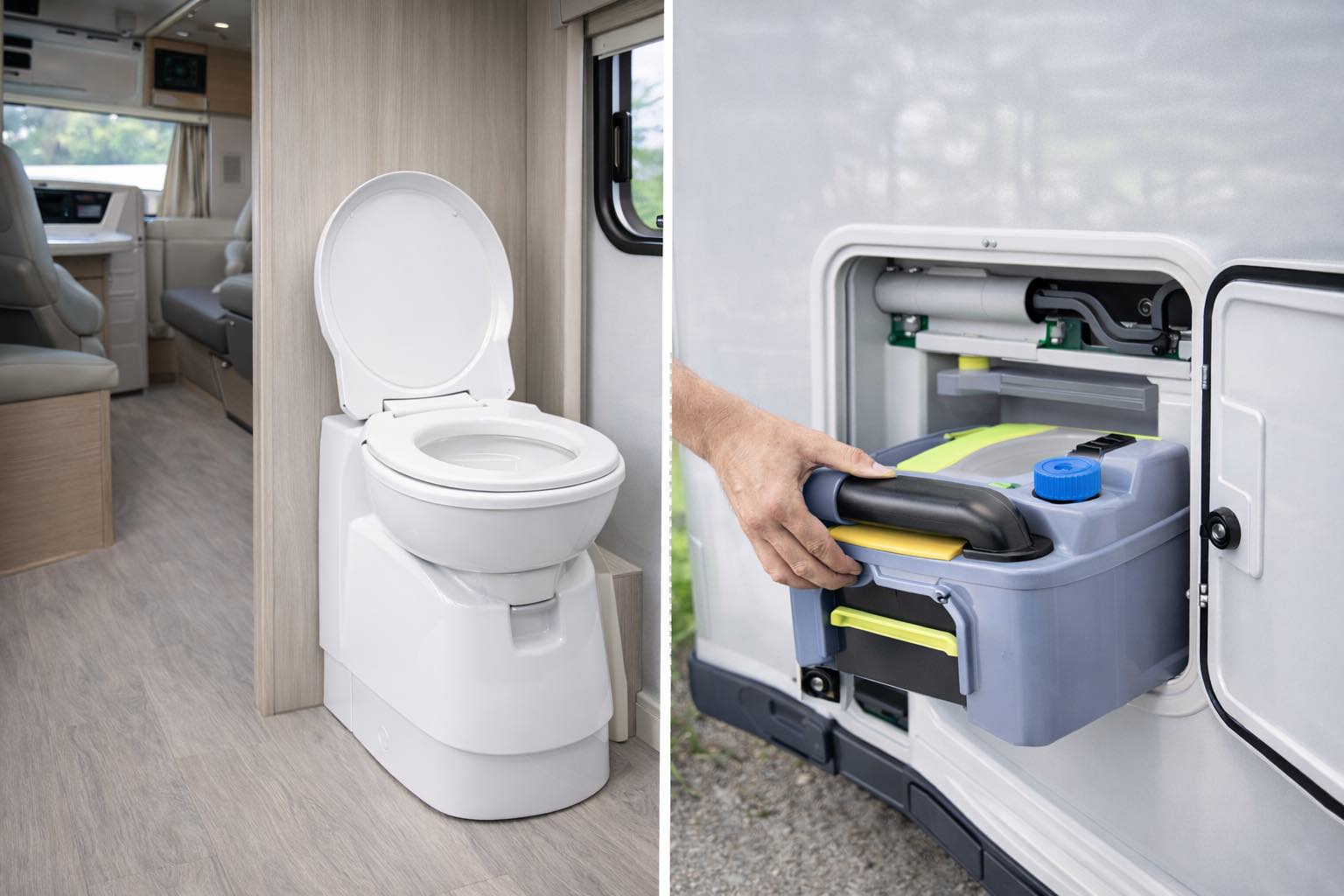
Cassette Toilets
How it works: a permanently mounted bowl in the bathroom + a removable cassette (typically 16–19 L) that is pulled out through a service hatch on the outside of the RV and emptied at a dump point. Flush is electric (12 V) or manual pump.
This is the most popular type in European motorhomes and caravans. Virtually all factory-built models from Dethleffs, Hymer, Knaus, and Adria come with a cassette toilet.
Installation: requires a recess for the cassette, an external service door, and a 12 V connection (for electric versions). Some models have a built-in flush water tank (7–15 L), while others connect to the main water tank.
Maintenance:
- Empty the cassette every 1–4 days (depending on the number of users and cassette volume)
- Sanitary additives (liquid or tablets) — per the instructions for each tank
- Lubricate the blade seal gaskets and rinse the cassette
Common issues:
- Odor during emptying — usually caused by incorrect additive dosing, high temperatures, or a dirty blade seal. Solution: proper dosing, regular rinsing, lubricating the seals.
- Leaking through seals — rubber deteriorates over time. Solution: preventive replacement of seals and blade mechanism (OEM repair kits).
- Dependency on infrastructure — you need cassette dump points. This is the main limitation for long routes without campgrounds.
Current models:
| Model | Cassette | Flush Tank | Weight | Features |
|---|---|---|---|---|
| Thetford C260 (C263 series and others) | 17.5 L | Connected to main tank | 7–9 kg | Multiple configurations by height and bowl shape |
| Thetford C220 | 18 L | Connected to main tank | 6.8–8 kg | Compact dimensions (495–727 mm in height) |
| Thetford C400 (C402-X / C403-L) | 19.3 L | 15 L (built-in) | ~8 kg | Self-contained flush water tank, level indicator |
| Dometic CTW 4110 | 19 L | 7 L (built-in) | 12.25 kg | 12 V; dimensions 530 x 672 x 382 mm |
| Dometic Saneo CS / CW | 16 L | 7 L (CW version) | 12.7–13.5 kg | Swiveling bowl up to 90 degrees in both directions, touch display |
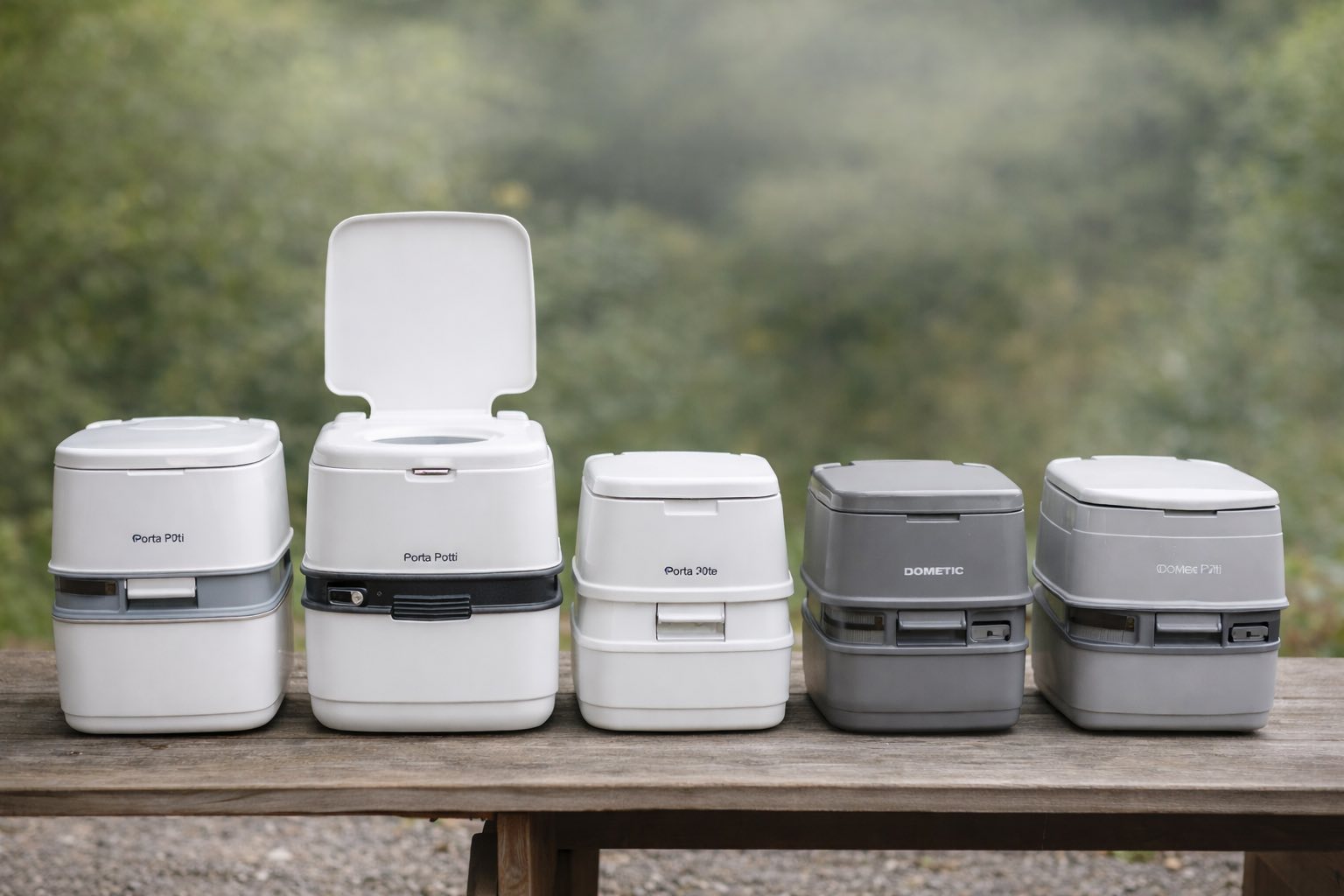
Portable Toilets (Porta Potti)
How it works: two tanks in one unit — the upper tank holds clean water (for flushing), the lower tank holds waste. The entire unit is carried as one piece and emptied manually. This is the quickest way to get a self-contained toilet without any built-in installation.
Ideal for: van conversions, micro-campers, outdoor camping, or as a temporary solution.
Installation: minimal — sometimes a mounting base or straps are used for safety during travel. No electricity needed (piston pump), but models with electric flush are available.
Common issues:
- Sloshing and odor during transport — don't overfill the tank, use additives, choose a model with a good valve and level indicator.
- Uncomfortable height — pay attention to the seat height when purchasing (especially for taller users).
Current models:
| Model | Waste Tank | Flush Tank | Weight | Dimensions (mm) | Flush |
|---|---|---|---|---|---|
| Thetford Porta Potti 365 | 21 L | 15 L | 4.0 kg | 414 x 383 x 427 | Piston |
| Thetford Porta Potti 565E | 21 L | 15 L | 5.0 kg | 448 x 388 x 450 | Electric |
| Thetford Porta Potti 335 | Compact | Compact | ~3.5 kg | 313 x 342 x 382 | Piston |
| Dometic 972 | 9.8 L (2.6 gal.) | 8.7 L | 5.44 kg | 387 x 333 x 317 | Piston |
| Dometic 975 | 18.9 L (5 gal.) | 11.3 L | 6.35 kg | 387 x 333 x 387 | Piston |
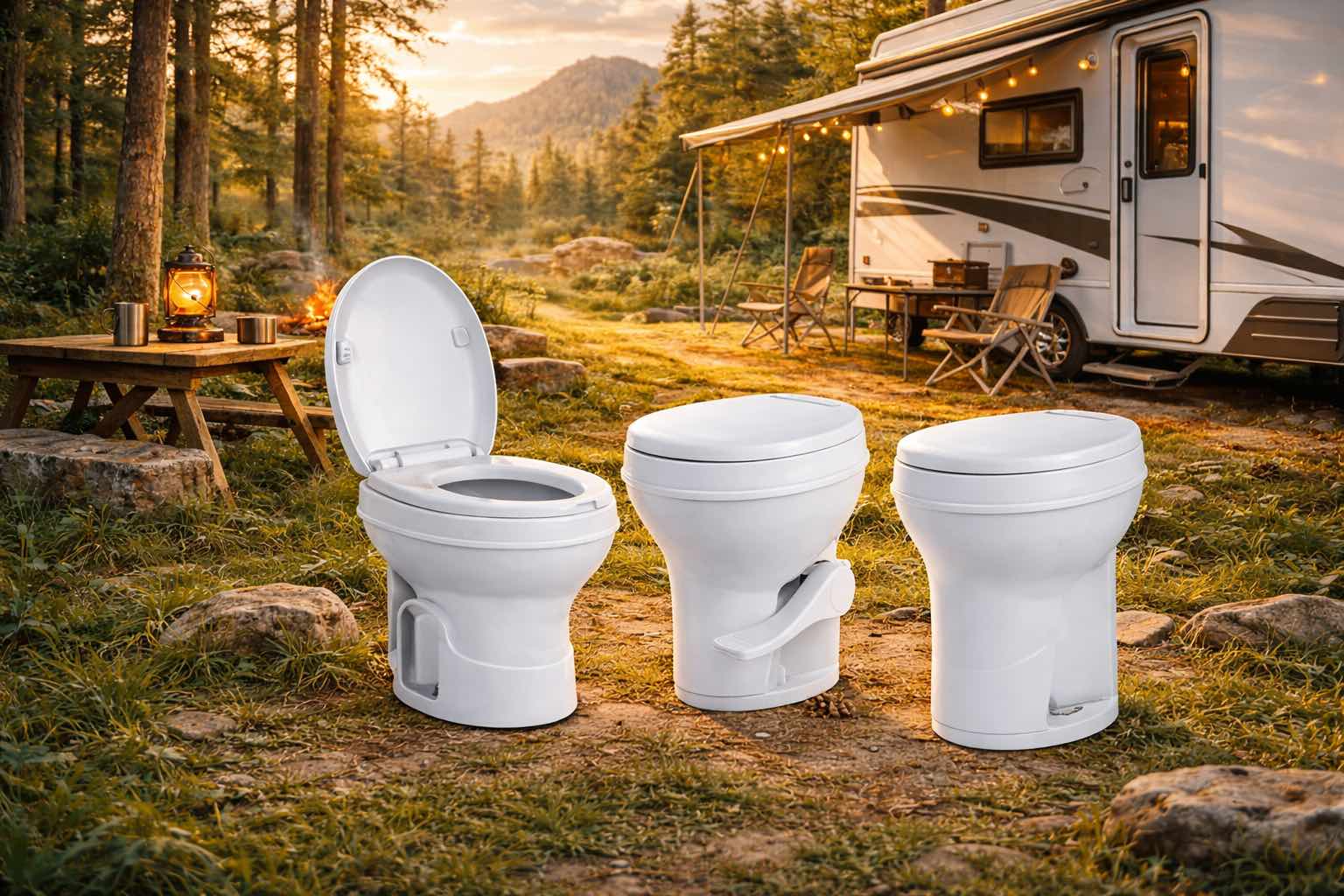
Gravity Flush Toilets
How it works: a permanently installed toilet with a pedal or manual valve — pressing the pedal opens the blade, and waste drops into the black tank (holding tank) located beneath the RV floor. Water flush occurs simultaneously when the blade opens.
This is the standard type for factory-built RVs in North America (Class A, B, C RV). Nearly all American trailers and motorhomes come with a gravity flush toilet and black tank.
Installation: requires permanent mounting above the black tank, connection to the RV's water system. No electricity needed for the toilet itself (mechanical pedal), though it may be needed for tank level sensors.
Maintenance:
- Empty the black tank via a dump hose at designated dump stations
- Black tank additives (tablets or liquid) for odor control and waste breakdown
- Tank rinsing — via a built-in nozzle (backflush) or external hose
Advantages:
- Extremely simple and reliable design — minimal parts that can break
- Large tank volume (40–150 L) — less frequent dumping needed
- Low cost for both the toilet and consumables
- Feels like a home toilet with a full-size ceramic or plastic seat
Disadvantages:
- Requires a black tank under the floor — not suitable for van conversions without major modifications
- Depends on dump stations (though the network is well-developed in North America)
- Odor when the blade opens — addressed with ventilation and additives
Current models:
- Dometic 300 / 310 / 320 series — basic plastic models for most American RVs. Pedal flush, lightweight (3–5 kg), affordable.
- Thetford Aqua-Magic V / Style II / Style Plus — similar solutions with pedal flush and various bowl designs (standard / elevated height).
- Dometic 320 series — version with a ceramic bowl for the premium segment, closer to a home toilet experience.
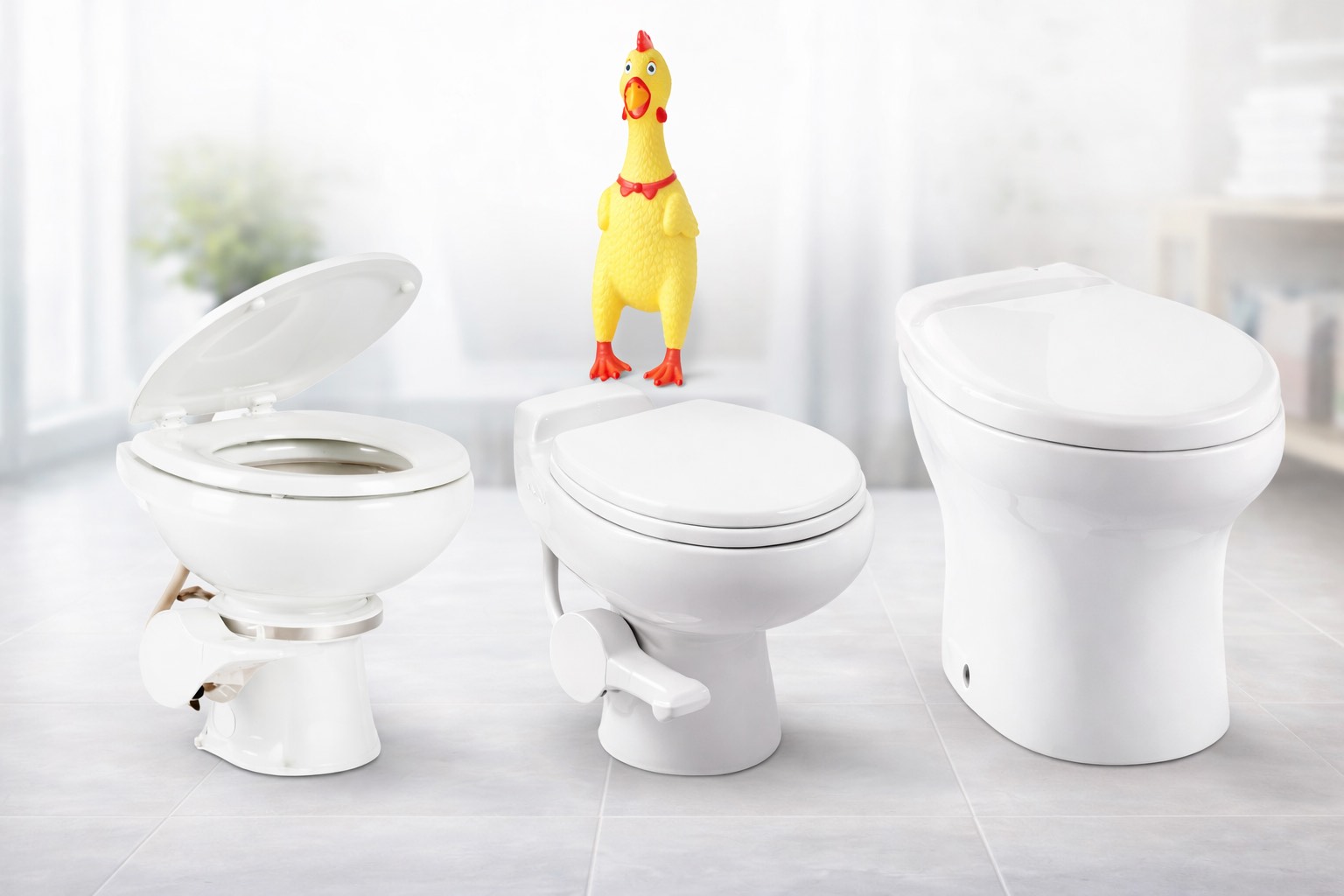
Vacuum Flush Toilets
How it works: instead of gravity, vacuum is used to transport waste. Pressing a button/pedal creates suction that pulls the contents into the black tank. Significantly less water is needed per flush (typically 0.3–0.5 L instead of 1–2 L for gravity flush).
Origin: the technology came from the marine industry (yachts, boats) and aviation. Main manufacturers — Dometic (VacuFlush lineup) and SeaLand.
Installation: 12 V for the vacuum pump; connection to the black tank via a vacuum line. Installation is more complex than gravity toilets — requires a vacuum pump, airtight connections, and check valves.
Advantages:
- Water savings — uses 3–5 times less water than gravity flush
- Flexible installation — the toilet doesn't have to sit directly above the tank; vacuum allows routing the line horizontally and even upward
- Less odor — the vacuum line is sealed, preventing tank odor from rising
- Quiet operation — modern models run significantly quieter than macerating toilets
Disadvantages:
- High cost (toilet + vacuum generator)
- Depends on electricity — won't work without 12 V
- More complex maintenance — vacuum line integrity is critical
Current models:
- Dometic VacuFlush series (4709 / 4748 / 5048) — the main vacuum toilet lineup for RVs. Porcelain or plastic bowl, pedal or push-button flush, water usage ~0.5 L per flush.
- SeaLand VacuFlush — marine models adapted for expedition motorhomes and large Class A RVs.
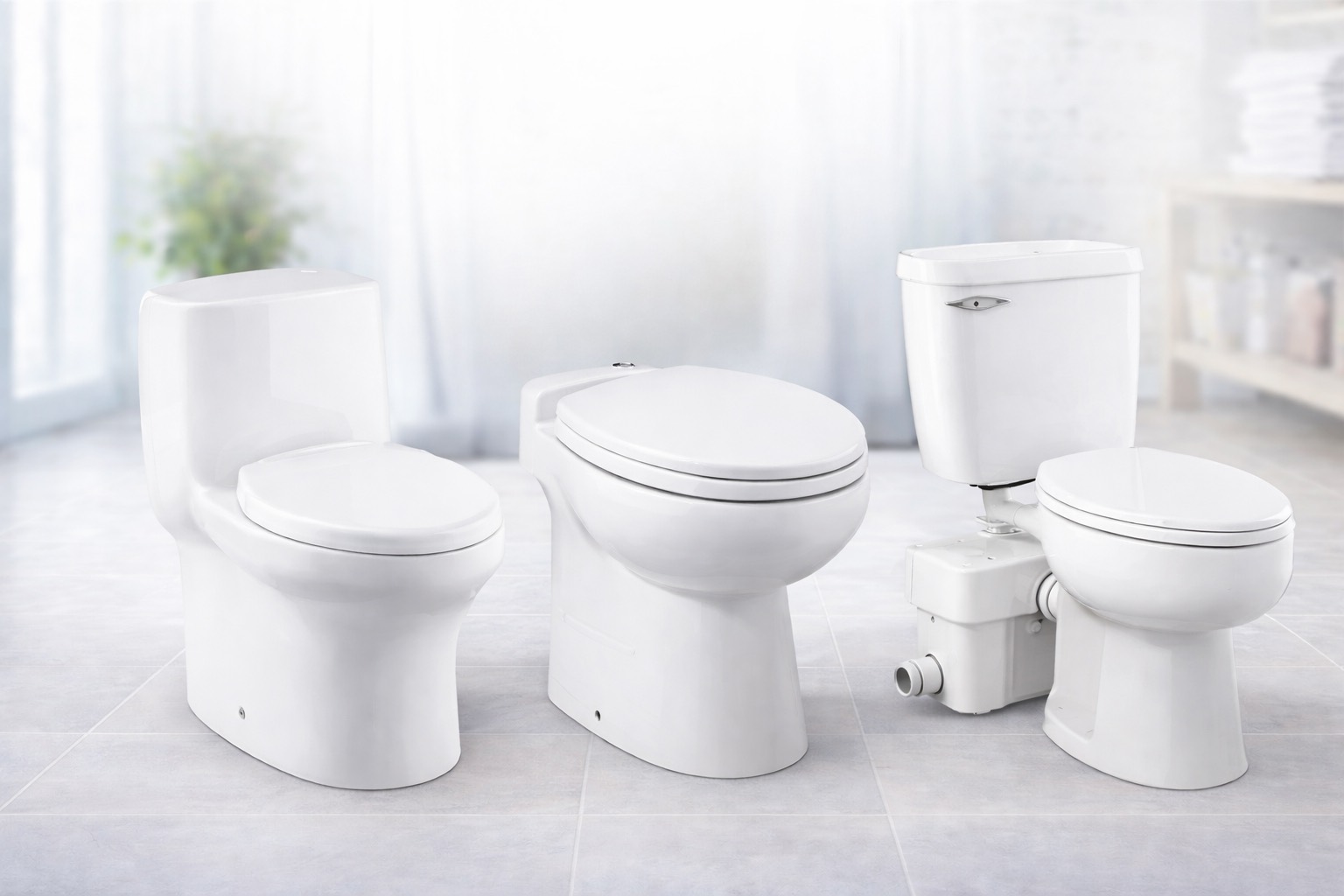
Macerating Toilets (Grinding + Pump)
How it works: waste is ground up by a built-in macerator (blade pump) and pumped into the black tank or disposal system through a narrow pressure line (typically 25–38 mm instead of the standard 75–100 mm). This reduces the risk of clogs and allows flexible plumbing routing in tight spaces.
Installation: 12 V for the macerator motor; requires fittings, check valves, and airtight connections. Installation is more complex than a standard gravity toilet.
Common issues:
- "What not to flush" — wet wipes, hygiene products, and large objects will jam the impeller. Only RV-safe dissolving toilet paper!
- Noise and vibration — the macerator is louder than a gravity flush. Mounting on vibration isolators helps.
- Service access — choose models with access to the motor/impeller and install service hatches.
Current models:
| Model | Power | Weight | Dimensions (mm) | Features |
|---|---|---|---|---|
| Dometic MasterFlush 8920 | 12 V | 13.83 kg | 464 x 375 x 375 | Compact macerator for RVs |
| Dometic MasterFlush 8541 | 12 V | 28.35 kg | ~559 mm depth | Version with bidet seat |
| Saniflo Sanicompact | Mains | — | Compact | Built-in macerator, small-diameter pressure line |
| Liberty Pumps Ascent II | Mains | — | — | Pumps up to 7.6 m vertically / 45 m horizontally |
| Jabsco Quiet Flush E2 | 12 V (25 A) | — | — | Marine model, adaptable for expedition builds |
"Bag and Dispose" Class: Dry Flush, Sealing, and Auto-wrapping
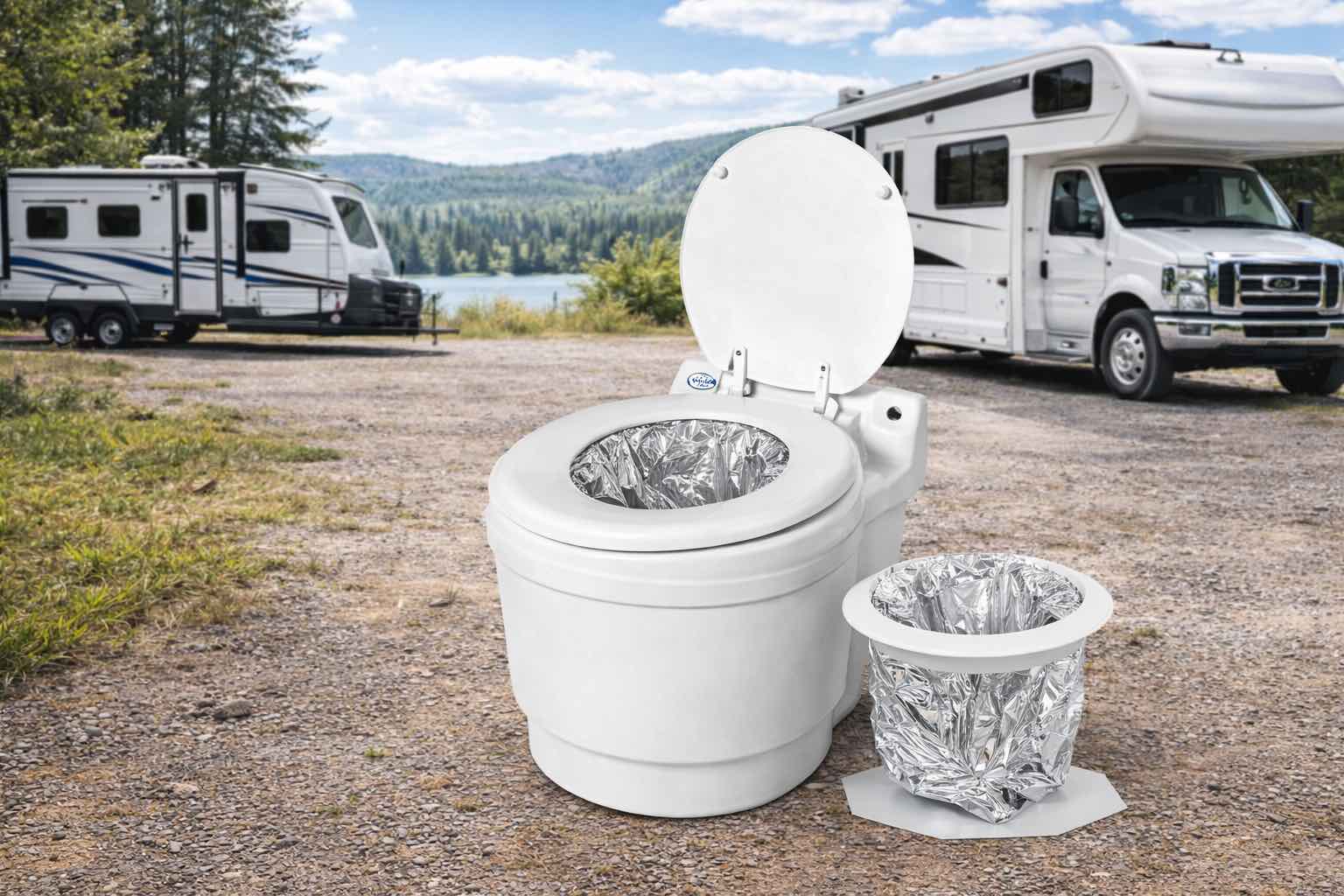
This is the fastest-growing segment in recent years. Waste never enters a tank and doesn't require dumping at a sewer — it is hermetically sealed in a barrier material and disposed of as household trash (subject to local regulations). The main advantage is complete independence from dump infrastructure and no water needed.
Dry Flush (Cartridge with Bag)
How it works: with each "flush," waste is wrapped and sealed inside a multi-layer bag from a replaceable cartridge. One cartridge provides approximately 15 flushes. The used cartridge is replaced entirely.
Key brand: Laveo (the brand that created this category).
Installation: 12 V for the wrapping mechanism. Setup is minimal — place the unit, connect power. No ventilation required.
Pros:
- Virtually zero odor — waste is hermetically isolated
- No water and no dump infrastructure needed
- Simple installation — set it up and it works
Cons:
- Highest consumable costs of any toilet type — cartridge costs add up significantly with frequent use
- Limited number of flushes per cartridge (~15)
- Need to stock cartridges for the trip
Current models:
- Laveo DryFlush Portable Toilet — 12 V, weight 12.5 kg, dimensions 464x407x508 mm. Often bundled with a 12 V battery and starter cartridges.
- Laveo DryFlush Refill Cartridges — replacement cartridges, ~15 flushes each. Packs from 1 to 6 units.
Sealing (Heat-Sealed Barrier Film)
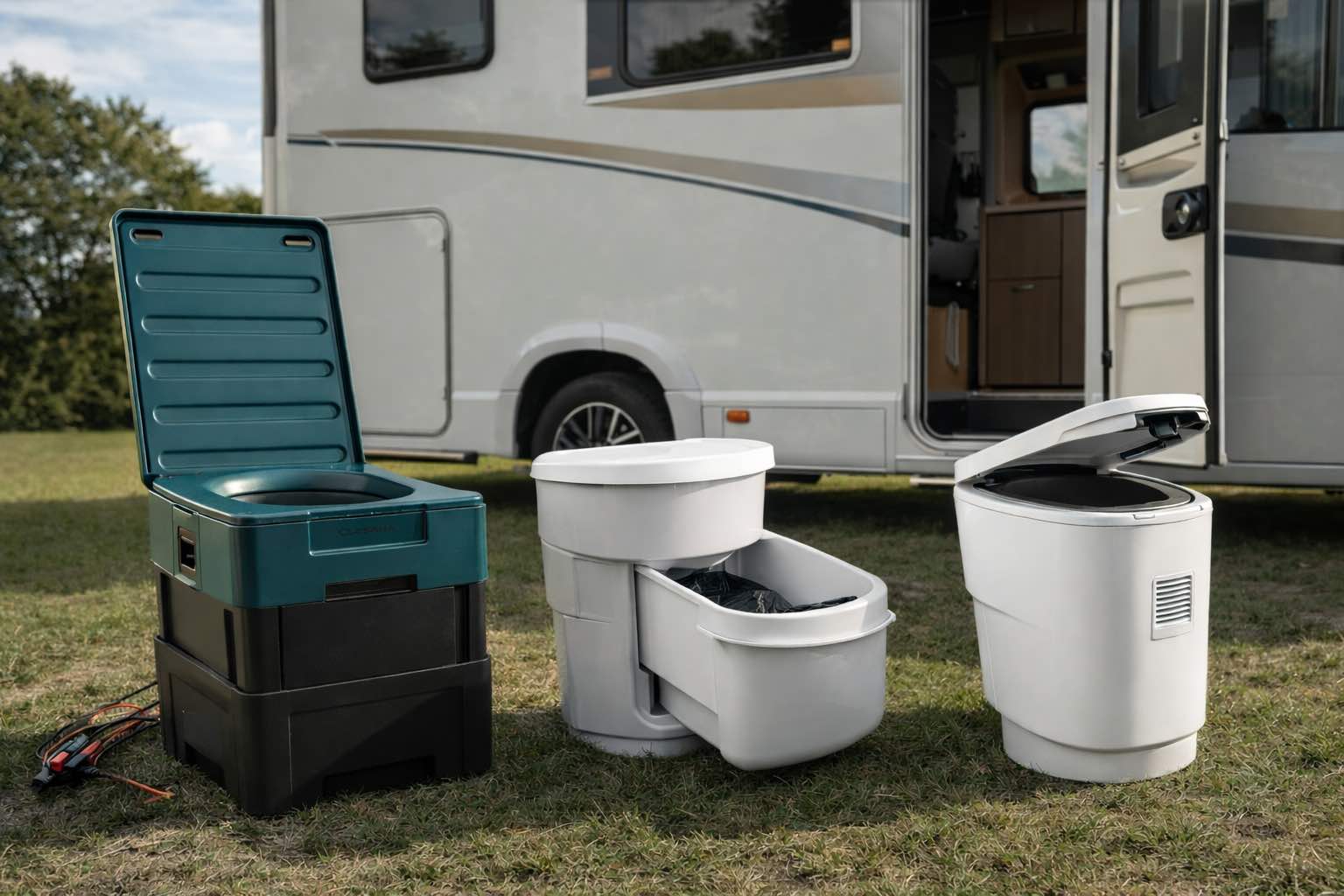
How it works: waste is sealed by heat welding in multi-layer barrier film. The average capacity is 40 "bags" per liner (film roll). The PTFE tape (anti-adhesion element) is replaced separately and lasts approximately 1,500–2,000 cycles.
Key brand: Clesana (a German company specializing in waterless sealing systems).
Installation: 12 V; proper seating, access to the bag compartment, and cleanliness of the sealing zone are important.
Pros:
- Zero odor when operated correctly
- More uses per liner (~40) compared to Dry Flush (~15)
- Lower cost per use than Dry Flush
- No water, no dumping
Cons:
- High purchase price
- Sealing errors if foreign material enters the welding zone
- Need to monitor the condition of the PTFE tape and keep the mechanism clean
Current models:
| Model | Power | Weight | Dimensions (mm) | Capacity |
|---|---|---|---|---|
| Clesana C1 | 12 V | 13.5 kg | 363 x 461–516 x 515 | ~40 uses / liner |
| Clesana X1 / X1 ProCharge | 12 V | — | Portable format | ~40 uses / liner |
Trend: Clesana has announced the release of "bio" barrier liners made from biomass and recycled plastic starting in 2025 — a move toward eco-friendly consumables.
Auto-wrapping (Automatic Bag Wrapping)
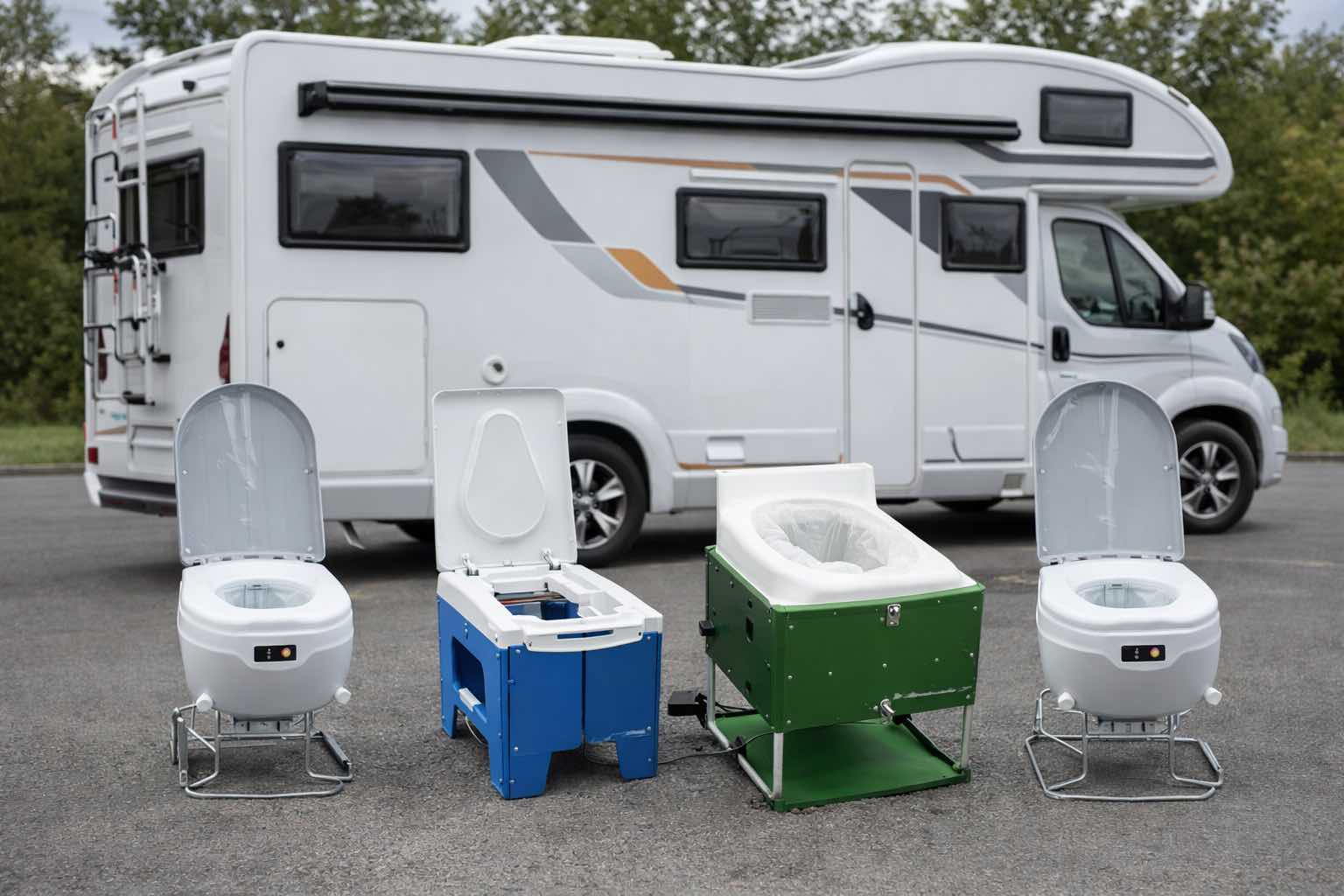
How it works: waste is automatically wrapped in individual sealed bags. Similar to Dry Flush, but technically a separate approach — bags are often dispensed from a roll rather than a single cartridge-bag unit.
Key brand: Wrappon (a Japanese brand).
Current models:
- Wrappon PF-1 — a system that seals waste in individual bags; 30–50 "flushes" per film set.
- Wrappon Sunny / Trekker — portable versions of various sizes, weighing from ~4 to ~12 kg.
Note: Wrappon consumable prices vary significantly by market (manufactured in Japan, limited distribution). When purchasing, check the cost of film sets for your region.
"Process On-Site" Class: Incineration, Composting, and Separating
Waste is processed right inside the RV: burned to ash, composted, or separated into fractions for simplified disposal. The common trait is maximum independence from sewer infrastructure, but each type has its own requirements for energy, ventilation, and maintenance discipline.
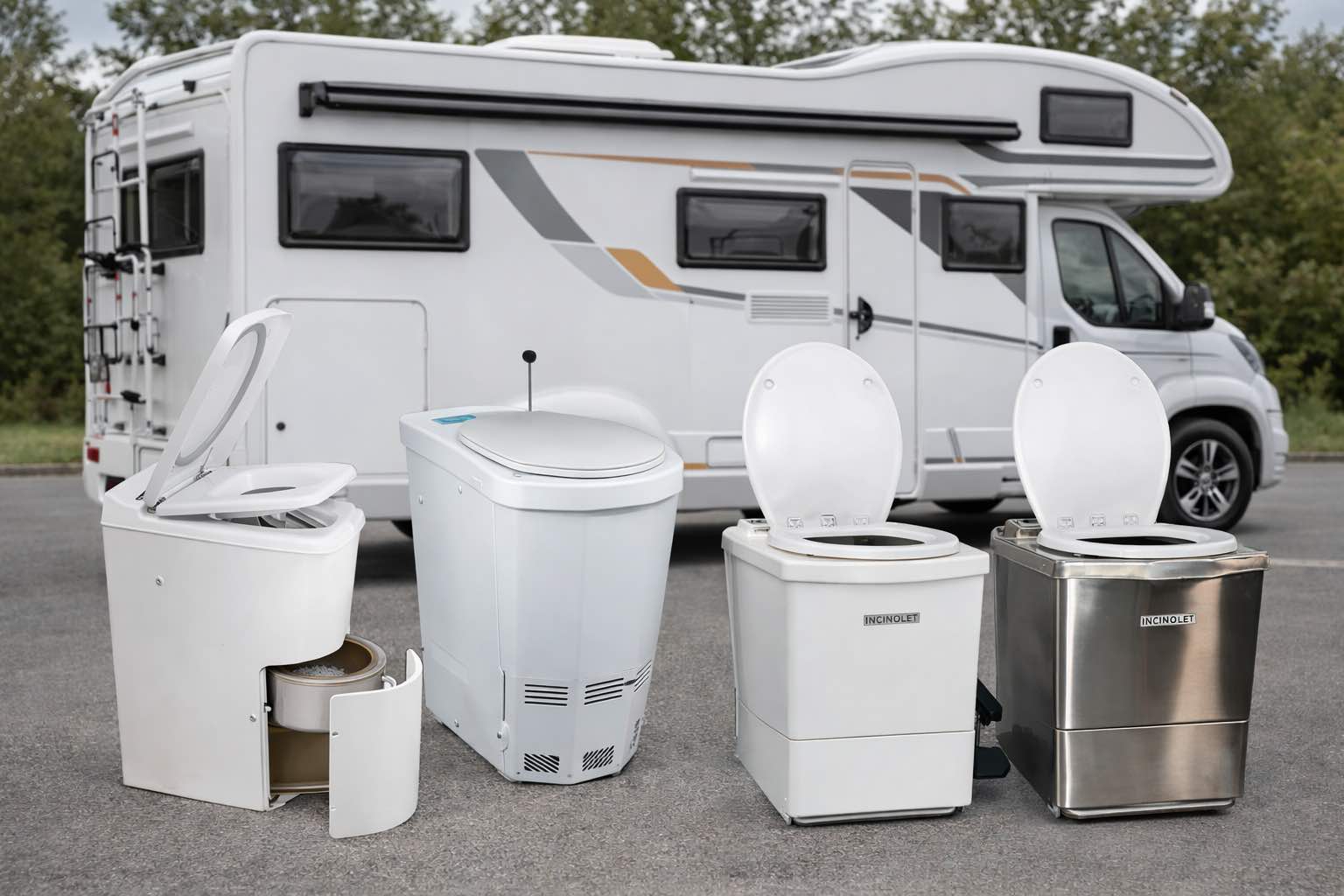
Incinerating Toilets
How it works: waste is burned in a chamber at high temperature and reduced to sterile ash (ash volume is a fraction of the original). No water is needed. Requires ventilation (exhaust flue to the outside) and significant power.
Two subtypes by energy source:
Electric
Requires dedicated electrical capacity. Example: Incinolet specifies 120 V/2000 W or 240 V/3500 W and a dedicated 20 A circuit. One cycle consumes approximately 1.5–2 kWh. This is a serious limitation for an RV — you need shore power or a powerful inverter + a large battery bank.
Gas / Diesel
Runs on propane, LPG, or diesel + 12 V for the electronics and fan. Example: Cinderella Travel uses 140–180 g of gas per incineration cycle on 12 V (4 A) power. More suitable for off-grid RV use.
Common issues:
- Ventilation is critical. Flue installation errors lead to odor and smoke inside. Strictly follow the manufacturer's instructions!
- Consumables — disposable bowl liners for combustion chamber hygiene.
- Cycle time — incineration takes from 30 minutes to several hours. The next use is only possible after the cycle completes (depending on the model).
Current models:
| Model | Power | Weight | Dimensions (mm) | Consumption per Cycle | Features |
|---|---|---|---|---|---|
| Cinderella Travel | Gas/diesel + 12 V (4 A) | 14 kg | 390 x 540 x 590 | 140–180 g gas | Compact, designed for vehicles |
| Cinderella Freedom | Propane + 12 V | 34 kg | 600 x 390 x 590 | — | Off-grid propane incineration |
| Cinderella Comfort | Electric ~2000 W | — | — | 0.8–1.5 kWh | Electric, for shore power |
| Incinolet Model TR | 120 V/2000 W (or 240 V/3500 W) | — | — | 1.5–2 kWh | Dedicated 20 A circuit |
| EcoJohn TinyJohn Gas | LPG/natural gas + 12 V | — | — | Varies by version | Gas incineration |
Important: incineration is not "simply replacing a cassette" — it's a separate infrastructure inside your RV: exhaust flue, heat shielding, power/fuel supply, liner stock. This is a solution for those ready for a serious installation project.
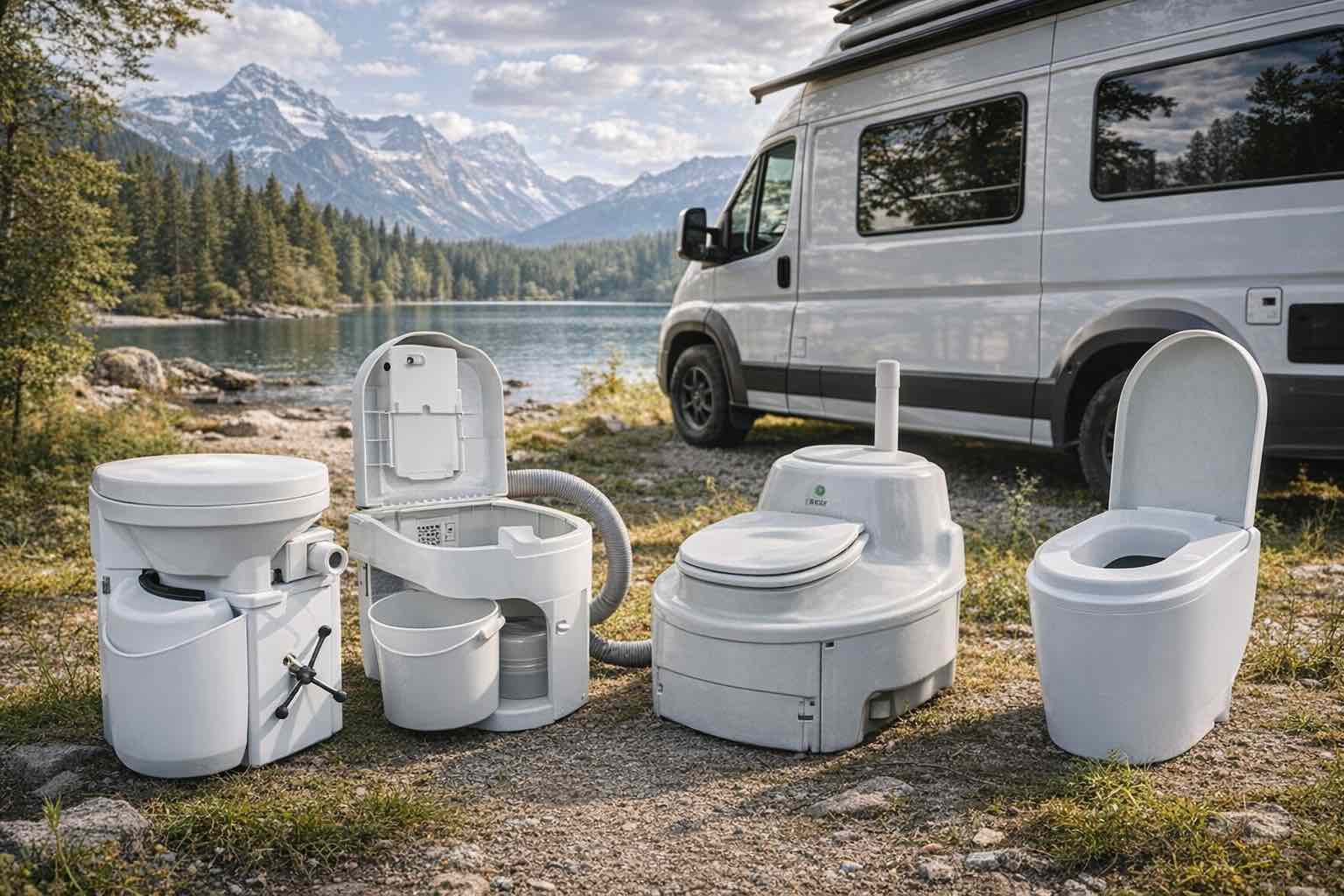
Composting Toilets
How it works: solid waste is stabilized inside a container with added bulking material (coconut coir, sawdust, peat). A fan exhausts moisture and odor through a vent pipe to the outside. The liquid fraction is usually diverted separately (into a jug or grey tank).
Important clarification: most "RV composting" toilets are actually separation + drying systems, not full composting systems. A complete composting cycle doesn't happen in 2–3 days in an RV. It's more accurate to call it "stabilization and drying."
Installation: requires a vent pipe to the outside + a low-power 12 V fan (typically 0.5–1 W).
Common issues:
- Odor — almost always indicates ventilation problems or an overly wet mix. Checklist: fan airflow, connection tightness, medium dryness.
- Gnats/insects — use a screen on the air intake and maintain discipline with the lid and moisture levels.
- Overflow — emptying frequency depends on the number of users. For 2 people, roughly every 3–6 weeks for the solids container.
Current models:
| Model | Weight | Dimensions (mm) | Fan | Capacity / Features |
|---|---|---|---|---|
| Nature's Head | ~12.7 kg | 483 x 483 x 533 | 12 V | A classic in its category; manual agitator crank |
| Air Head Classic / Standard | — | — | 12 V | ~80 uses; starter coconut coir brick |
| OGO Origin | — | — | 12 V (very low consumption) | Electric agitator + urine tank sensor |
| Sun-Mar GTG | — | Compact | 12 V (5 W) | Compact format for small spaces |
| BioLet 65 | — | Stationary | Mains (up to 355 W) | Automatic mixer; averages ~1.5 kWh — more suited for fixed installations |
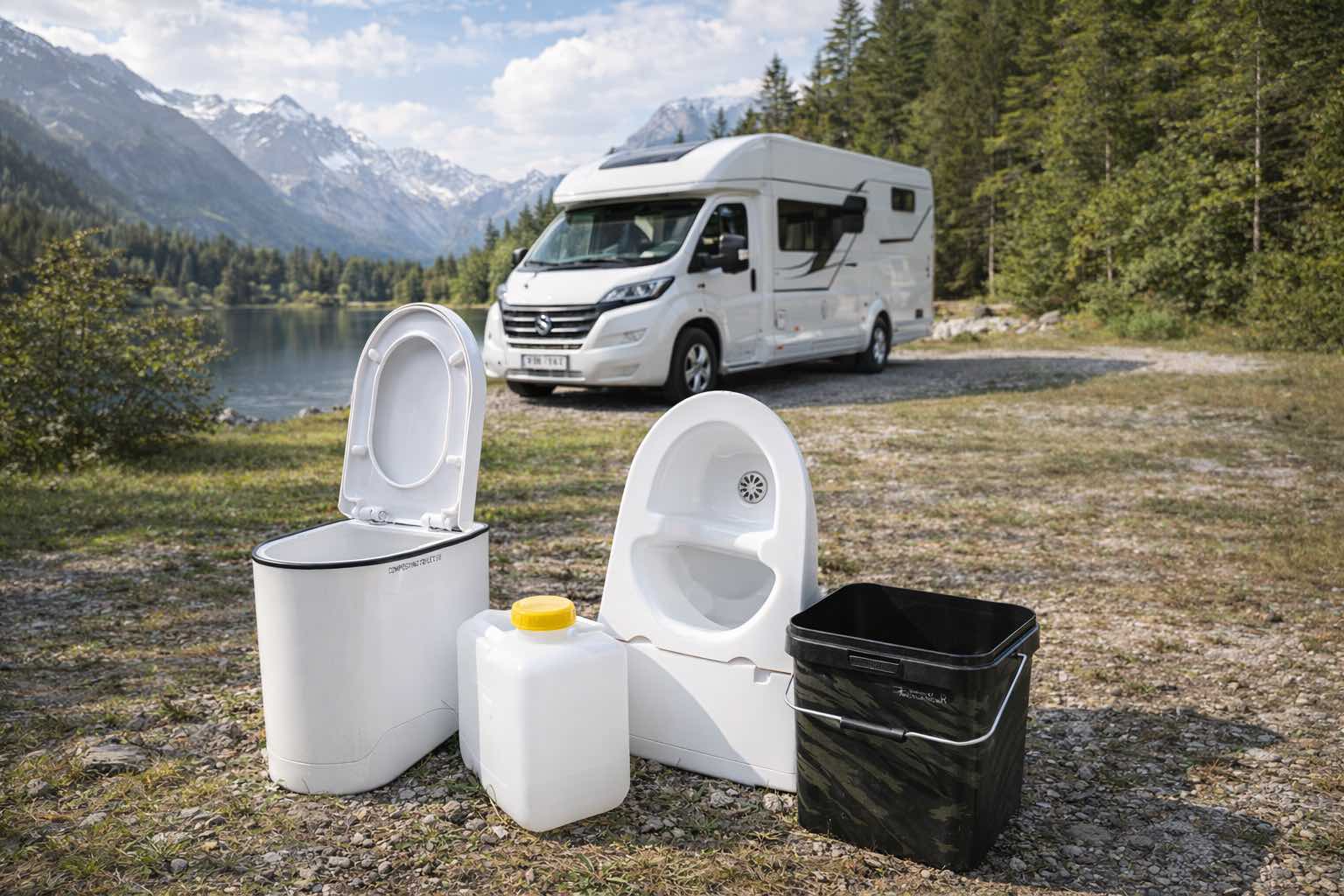
Separating Toilets (Urine-Diverting)
How it works: liquid and solid fractions are separated right in the bowl. Liquid goes into a separate jug (or is diverted to the grey tank), solids go into a container with a bag and/or bulking material. Separation reduces odor (ammonia forms when urine and feces mix) and simplifies maintenance.
Installation: ventilation is usually needed; many models are completely passive, or use a low-power fan (0.04 kWh/day for the Separett Tiny).
Common issues:
- Seating position — for proper separation, users must sit (not stand). This is important to communicate to all users.
- Liquid spills — a sealed jug and fill indicator are critical. Advanced models include sensors.
- Solids odor — addressed with ventilation and keeping things dry (bag + bulking material).
Current models:
| Model | Weight | Fan | Features |
|---|---|---|---|
| Separett Tiny | ~6 kg | 12 V (0.04 kWh/day) | Urine diverter format; minimal energy consumption |
| Trelino (Evo / Origin) | Varies by version | — | Portable separating toilets; various container sizes |
| Kildwick (separating series) | — | 12 V (optional) | Modular: vent kit, bags, containers sold separately |
| BOXIO Toilet | Ultra-lightweight | None | Ultra-compact format for van life and overlanding |
Note: some composting models (OGO Origin, Sun-Mar GTG) feel closer to separating toilets in practice — they also separate fractions but add a composting element for the solids.
"Smart Systems" Class: Automated RV Sanitation
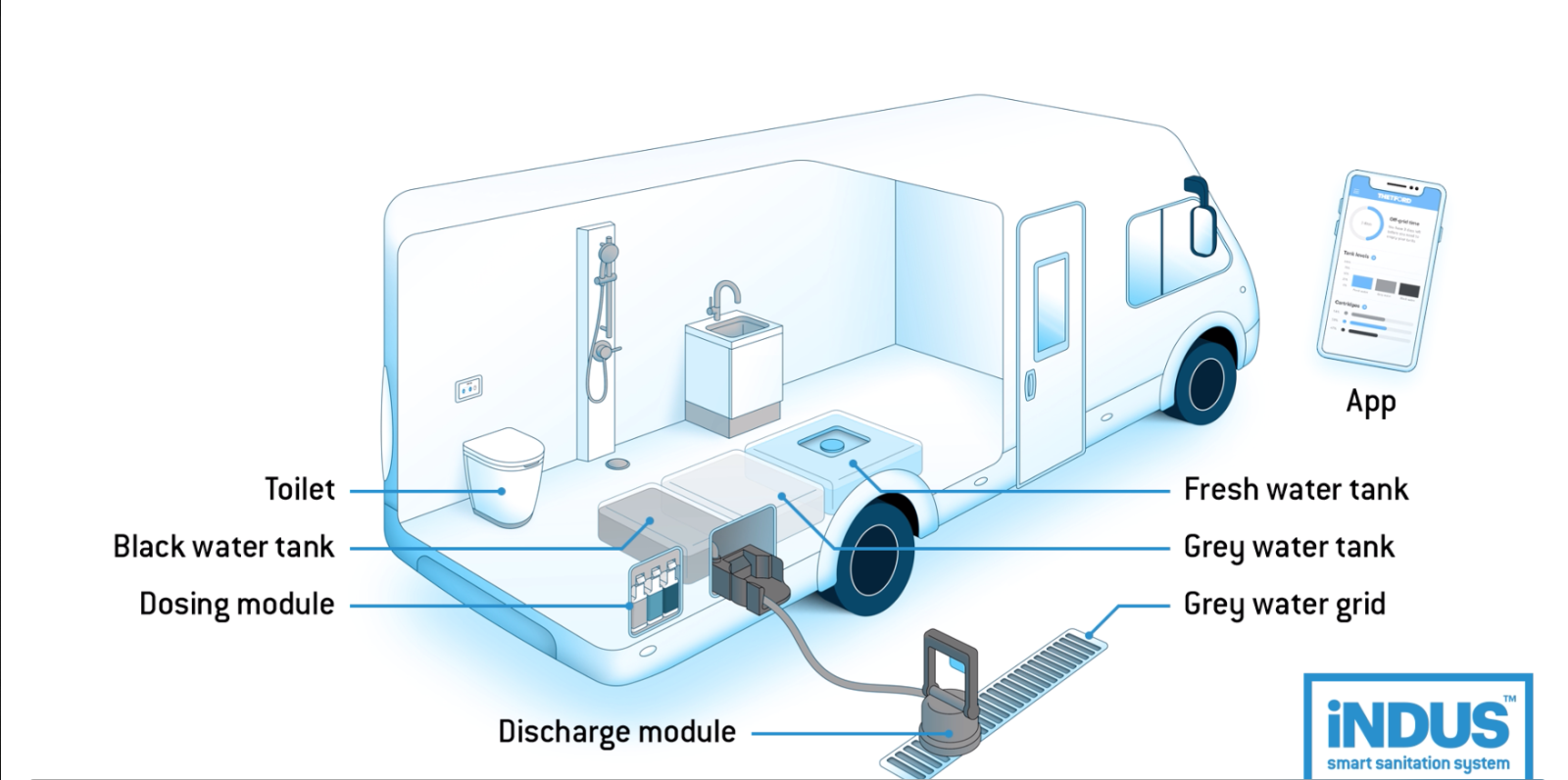
This is no longer "just another bowl type" — it's a sanitation system architecture: automatic additive dosing, tank level monitoring, dump station suggestions via an app, sometimes an integrated macerator and unified dump module.
Why this matters: users want less routine and fewer errors — incorrect chemical dosing at different temperatures and usage intensities is the cause of most odor problems in cassette and tank-based systems.
Current example:
- Thetford iNDUS — described as a "smart sanitation system." Includes:
- Automatic additive dosing (three modules: A — black water, B — flush water, C — grey water)
- An app for monitoring tank levels and locating nearby dump points
- A macerating toilet included in the package
- Additive cartridges are replaced on average every 28 days
- Off-grid autonomy — up to one week (per the manufacturer's claims)
Trend: the emergence of "smart" sanitation systems is changing the very question being asked. Instead of "which toilet should I choose," it becomes "which sanitation system should I integrate into my RV."
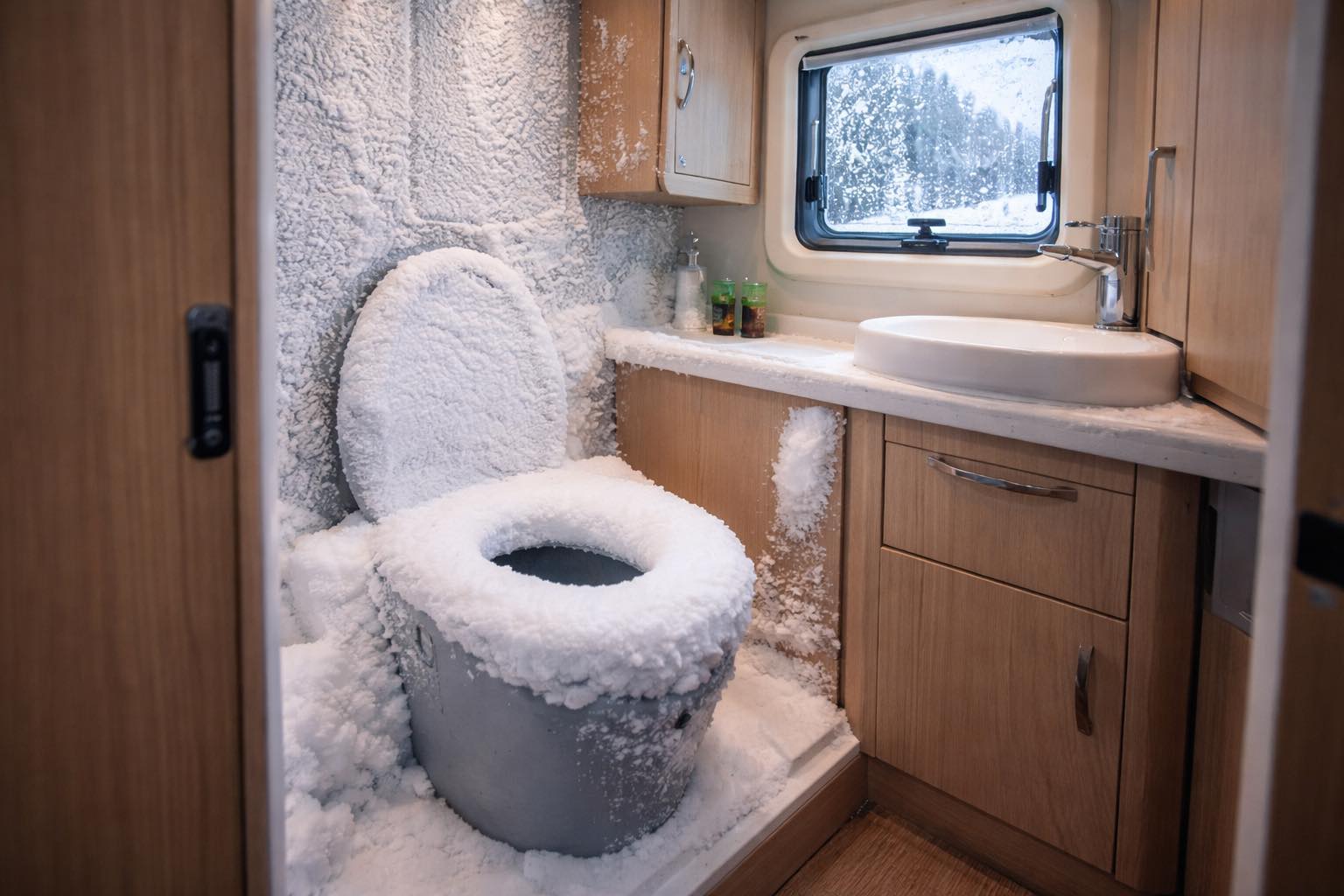
Niche Technologies: Freezing Toilets
For completeness, it's worth mentioning freezing toilets — an extremely niche Scandinavian solution where waste is frozen in an insulated container. Frozen waste produces no odor and is easy to transport for disposal.
Examples: Separett Freeze. Used primarily in Scandinavian summer cottages (stugor) and extremely rarely in RVs due to the energy required for freezing. For motorhomes, this is an exotic option, but the technology exists.
How Much Does It Cost: Annual Expense Calculation
To keep things concrete, let's set a specific scenario: 60–90 travel days per year, a family of 2–4 people, ~4 uses per person per day. Total: 600–1,200 uses per season.
Consumables by Type
| Type | Main Consumable | Usage per Season (60–90 days) | OPEX Estimate |
|---|---|---|---|
| Cassette / Portable | Sanitary liquid or tablets (per tank) | Depends on dump frequency. Guideline: ~60 mL of liquid per 20 L tank | Low–Medium |
| Gravity / Vacuum | Black tank additives + RV toilet paper | Depends on tank volume and dump frequency | Low |
| Dry Flush | Laveo cartridges (~15 flushes each) | 40–80 cartridges per season | Very High |
| Sealing | Barrier liners (~40 uses each) + superabsorber | 15–30 liners per season | Medium–High |
| Auto-wrapping | Film sets (30–50 flushes each) | 12–40 sets per season | High |
| Incineration (electric) | Electricity (1.5–2 kWh/cycle) + liners | Depends on rate; formula: uses x kWh x rate | High |
| Incineration (gas) | Propane/diesel (140–180 g/cycle) + liners | Depends on gas price | High |
| Composting / Separating | Bulking material (coconut coir/sawdust) + bags + ventilation (fraction of a watt) | A few bricks of medium + a pack of bags | Low |
Formula for your own calculation:
OPEX per season = (number of uses / consumable capacity) x consumable price + electricity/gas
Tip: when comparing options, calculate the "cost per use" — it's the most honest metric. For composting/separating systems, it approaches zero; for Dry Flush, it's at its highest.
How to Choose: Decision Matrix
Your ideal toilet type depends on the answers to four questions:
| Your Situation | Recommended Types | Why |
|---|---|---|
| Factory-built European motorhome, campgrounds with infrastructure | Cassette (already installed) | Optimal balance of cost and convenience with dump points available |
| Factory-built American RV, dump stations available | Gravity / Vacuum (already installed) | Large tank, infrequent dumping, simplicity |
| Van conversion, minimal space, no major installation | Portable / Separating / BOXIO | No recess or complex installation needed |
| Wild camping, no dump infrastructure, need self-sufficiency | Separating / Composting / Sealing | Independent of sewer connections |
| Maximum comfort, unlimited budget | Sealing (Clesana) / Incineration (Cinderella) | Minimum odor and contact with waste |
| Minimum budget, maximum simplicity | Portable (Porta Potti) / Separating | Low purchase price and consumable costs |
| Eco-friendliness is a priority | Composting / Separating | Minimal chemicals, waste can become compost |
| Premium RV, want to "forget about sanitation" | Smart system (Thetford iNDUS) | Automation handles the routine for you |
Trends and New Technologies 2024–2026
- Auto-dosing and eliminating human error — iNDUS from Thetford shows the direction where the system itself doses additives based on usage data and temperature.
- Sensors and user-friendly interfaces — Dometic Saneo with a touch display and swiveling bowl; OGO Origin with a capacity sensor and electric agitator.
- Eco-friendly consumables — barrier liners made from biomass and recycled plastic (Clesana, starting 2025); biodegradable cassette additives.
- Integration with RV systems — tank monitoring, dump station suggestions, linking with telematics and energy systems. Sanitation is becoming part of a unified "smart home on wheels."
- Energy efficiency vs. comfort — on one end, separating/composting systems consuming a fraction of a watt; on the other, incineration consuming kilowatts per cycle. The choice is a matter of your specific RV's energy balance.
Frequently Asked Questions (FAQ)
What's best for off-grid camping without campgrounds?
Sealing/Dry Flush or separating/composting. The former offer minimal contact with waste but high costs. The latter are the cheapest to operate but require discipline and proper ventilation.
Why does my cassette toilet smell even with chemicals?
Most often the cause is: incorrect additive dosing (especially in hot weather — you need more), a dirty blade seal, or air leaking through worn gaskets. Solution: clean the blade, lubricate the seals, dose chemicals correctly per the instructions.
Do waterless toilets need 12 V power?
For Dry Flush (Laveo) and Sealing (Clesana) — yes, the wrapping/sealing mechanism runs on 12 V. For separating toilets — usually no (or only a fan consuming a fraction of a watt).
Is an incinerating toilet always odor-free?
With correct ventilation and following the instructions — odor is minimal. But with flue installation errors or power failures (fan stops running) — odor and smoke are possible. Manufacturers themselves warn about this in their manuals.
What's the difference between a separating and a composting toilet?
A separating toilet simply diverts liquid and solid fractions. A composting toilet adds stabilization of the solid fraction (drying, microbiology) with bulking material and active ventilation. In practice, the difference in an RV is small — "full composting" doesn't happen in 2–3 days.
Can I install a macerating toilet instead of a cassette?
Technically — yes, but it's a different architecture: you need a black tank, a pressure line, a 12 V pump, check valves, and service access. Consider the space, power, and route (you'll need dump stations). For van conversions, this is usually overkill.
Which type is the quietest?
Gravity flush (pedal valve — silent) and separating/composting (only a quiet fan). The loudest are macerating (grinder motor) and vacuum (vacuum pump).
Can I use regular toilet paper?
In cassette, gravity, and macerating toilets — it's better to use fast-dissolving RV toilet paper (or single-ply without additives). In Dry Flush / Sealing — any kind, it gets sealed along with the waste. In composting/separating — usually in a separate container or any type (depends on the model).
What are "grey tank" and "black tank"?
Black tank (black water tank) — for toilet waste. Grey tank (grey water tank) — for water from the sink and shower. This is standard terminology used worldwide.
Which sanitary additives should I choose for a cassette?
Main brands: Thetford (Aqua Kem Blue/Green/Rinse), Dometic (GreenCare/PowerCare). "Green" versions are eco-friendly (can be dumped into regular sewers). Dosing — strictly per instructions, typically 60 mL per 20 L tank or 1 tablet per tank fill.
Conclusion
There are more than a dozen fundamentally different toilet technologies for RVs on the global market. There is no single "right" answer — there is the right answer for your specific situation.
In short:
- For most owners of factory-built RVs, a cassette (Europe) or gravity flush (North America) is what's already installed, and it works well with proper maintenance.
- For van lifers and off-grid enthusiasts — separating or composting (affordable, eco-friendly) or sealing (comfortable, but more expensive).
- For those who want to forget about the routine — smart systems (Thetford iNDUS) or Dry Flush (simple, but expensive on consumables).
- For expedition vehicles and full self-sufficiency — incineration (if you have the power) or composting + separating (if power is limited).
The golden rule: before buying, calculate the cost per use for your typical season. That's more sobering than any marketing promises.
Last updated: February 2026
Advertisement
Recommended
All News © bez.coffee
Industry
Article
3 days ago
Motorhomes 2026: A Global Overview of Trends and Tendencies
The coffee.bez.coffee editorial team analyzed 3,581 news stories from 56 countries in early 2026. Declining sales in Germany and the USA, Hyundai electric campers, budget Wuling motorhomes, KAMAZes with saunas in Russia, parking bans in Turkey — a comprehensive overview of motorhome industry trends by world region.
 © Kopaev Alex
Lifestyle
Article
Yesterday
Life in a Motorhome: Making the Dream of Freedom Come True
Two years on the road with a cat named Zhuzu — and not a single day of wanting to go back. We break down life in a camper van: where to find water, how heating works, what to do about electricity, and where to look for overnight spots. 7 countries, hundreds of places, and an honest account — from the mountain roads of Turkey to the coastline of Montenegro.
 © bez.coffee
Lifestyle
Article
2 days ago
Best Motorhome Apps 2026: How to Find the Perfect Parking and Camping Spot
Complete guide to the best apps for finding motorhome parking spots and campsites in 2026. Free and paid options for Russia, Europe, and worldwide.
You May Be Interested
All News © New Atlas
Industry
 Germany
Today
Germany
Today
Germany
Today
Mercedes-Benz moves Marco Polo camper van production fully in-house
Mercedes-Benz is bringing all production of the Marco Polo camper van in-house for the 2026 model year, ending its long-standing partnership with Westfalia. Key updates feature a new lightweight pop-up roof with more headroom and a skylight, alongside an enhanced MBAC smart control system. The updated models will debut at the Caravan Salon in Düsseldorf in August 2026.
 © RV PRO
Industry
 United States
Yesterday
United States
Yesterday
United States
Yesterday
Torklift Announces TailoredHitch for Airstream Basecamp Travel Trailer
Torklift has announced the TailoredHitch, a rear hitch solution designed specifically for the Airstream Basecamp 16' travel trailer. The 2-inch receiver hitch, with an estimated 300-pound tongue weight, is available for presale, while the version for the 20' model is in stock and ready to ship.
 © 브런치
© 브런치
Industry
 South Korea
14.01.2026
South Korea
14.01.2026
South Korea
14.01.2026
Compass RV unveils luxury CMF version of Hyundai Staria-based camper van
Compass RV Korea has revealed a premium CMF version of its Eurovan camper van, based on the Hyundai Staria. The update focuses on upgraded interior materials, a new color scheme, and redesigned furniture. The price for the CMF model has not been disclosed.
Latest News
All News © Adventure Magazine
Lifestyle
United States
Today
United States
Today
Camper van journey across North America to Alaska: experience and specifics
The article describes a three-week journey in a four-wheel-drive camper van from Seattle to Alaska. Key advantages cited are independence from infrastructure, the ability to stay overnight outside campgrounds, and route flexibility. The rental company GoNorth, mentioned in the material, permits the use of its RVs on gravel roads.
 © RV PRO
Lifestyle
United States
Yesterday
United States
Yesterday
RV Industry Launches RV-2-50 Campaign for America's 250th Anniversary
The RV industry's marketing campaign, Go RVing, has launched the RV-2-50 initiative ahead of America's semiquincentennial in July 2026. The year-long program features curated RV road trip itineraries and a travel passport system designed to drive foot traffic to dealers and campgrounds. The effort aims to position RV travel as a central part of the national celebration.
 © Islands
Lifestyle
United States
Yesterday
2
United States
Yesterday
2
Five top RV camping spots in Colorado selected
The article lists five RV camping locations in Colorado, chosen based on criteria including geography, scenery, and visitor reviews. The selection includes national monuments and parks like Dinosaur National Monument and Rocky Mountain National Park, with details on site availability and seasonal access.
 © ゲームウィズ
Lifestyle
Yesterday
Outbound camper van life game demo released on Steam
A free demo for the camper van adventure game Outbound is now available on Steam. Players can explore the first of four planned biomes alone or with up to three others in multiplayer. The full game is scheduled for release in summer 2026.
 © 4Gamer.net
Lifestyle
 Netherlands
Yesterday
5
Netherlands
Yesterday
5
Netherlands
Yesterday
5
Outbound camper van life game demo released on Steam
A demo version of Outbound, a multiplayer slow-life camper van adventure game, has been released on Steam. The demo features one of four planned biomes and offers about three hours of gameplay for up to four players. The full version is scheduled for release in Q2 2026 and will also be available on consoles.
 © Arizona Republic
Lifestyle
United States
Yesterday
United States
Yesterday
Arizona named top RV travel destination in North America
Arizona has been named the top destination for RV travel in North America for 2026. According to the Campspot Awards, Verde Ranch RV Resort in Camp Verde was ranked the number one RV campground, while Leaf Verde RV Resort in Buckeye secured second place for long-term camping.